
 Hyundai Sonata: Knock Sensor (KS). Description and Operation
Description
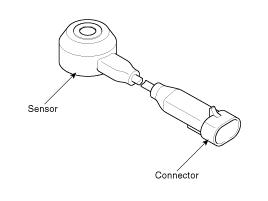
Knocking is a phenomenon characterized by undesirable vibration and noise
and can cause engine damage. Knock Sensor (KS) is installed on the cylinder
block and senses engine knocking.
When knocking occurs, the vibration from the cylinder block is applied
as pressure to the piezoelectric element. When a knock occurs, the sensor produces
voltage signal. The ECM retards the ignition timing when knocking occurs. If
the knocking disappears after retarding the ignition timing, the ECM will advance
the ignition timing. This sequential control can improve engine power, torque
and fuel economy.
 Camshaft Position Sensor (CMPS). Repair procedures
Inspection
1.
Check the signal waveform of the CMPS and CKPS using the GDS.
Specification:
Refer to “Wave Form�
...
 Knock Sensor (KS). Specifications
Specification
Item
Specification
Capacitance (pF)
850 ~ 1,150
...
See also:
Repair procedures
Inspection
Test the horn by connecting battery voltage to the 1 terminal and ground
the 2 terminal.
The horn should make a sound. If the horn fails to make a sound, replace
it.
Horn ...
Purge Control Solenoid Valve (PCSV). Schematic Diagrams
Circuit Diagram
...
Good driving practices
Never take the vehicle out of gear and coast down a hill. This is extremely
hazardous. Always leave the vehicle in gear.
Do not "ride" the brakes. This can cause them to overheat and ...
