
 Hyundai Sonata: Rail Pressure Sensor (RPS). Repair procedures
Inspection
| 1. |
Connect the GDS on the Data Link Connector (DLC).
|
| 2. |
Measure the output voltage of the RPS at idle and various engine
speed.
|
Removal
| 1. |
Turn the ignition switch OFF and disconnect the battery negative
(-) cable.
|
| 2. |
Release the residual pressure in fuel line (Refer to “Release
Residual Pressure in Fuel Line� in this group).
|

| 3. |
Remove the intake manifold (Refer to “Intake And Exhaust System�
in EM group).
|
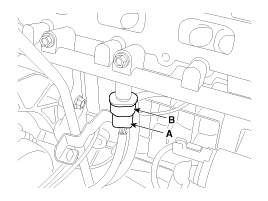
| 4. |
Disconnect the rail pressure sensor connector (A), and then remove
the sensor (B) from the delivery pipe.
|
Installation
|
| 1. |
Installation is reverse of removal.
|
 Rail Pressure Sensor (RPS). Schematic Diagrams
Circuit Diagram
...
 Accelerator Position Sensor (APS). Description and Operation
Description
Accelerator Position Sensor (APS) is installed on the accelerator pedal
module and detects the rotation angle of the accelerator pedal. The APS is one
of the most important senso ...
See also:
Automatic heating and air conditioning
1. Press the AUTO button. The modes, fan speeds, air intake and air-conditioning
will be controlled automatically according to the temperature setting.
Type A
Type B
2. Turn the tempe ...
Components and Components Location
Components Location
1. Input speed sensor
2. Output speed sensor
3. Solenoid valve connector
4. Oil temperature sensor
5. Valve body assembly
6. Solenoid va ...
California perchlorate notice
Perchlorate Material-special handling may apply, See www.dtsc.ca.gov/hazardouswaste/
perchlorate.
Notice to California Vehicle Dismantlers: Perchlorate containing materials, such
as air bag infla ...
