Inspection
|
1. |
Turn the ignition switch OFF.
|
|
2. |
Disconnect the PCSV connector.
|
|
3. |
Measure resistance between the PCSV terminals 1 and 2.
|
|
4. |
Check that the resistance is within the specification.
Specification:
Refer to “Specification�
|
|
Removal
|
1. |
Turn the ignition switch OFF and disconnect the battery negative
(-) cable.
|
|
2. |
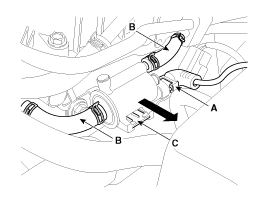
Disconnect the purge control solenoid valve connector (A).
|
|
3. |
Disconnect the vapor hoses (B) from the purge control solenoid
valve.
|
|
4. |
Remove the valve from the bracket (C) in the direction of the
arrow.
|
Installation
| •
|
Install the component with the specified torques.
|
| •
|
Note that internal damage may occur when the component
is dropped. If the component has been dropped, inspect before
installing.
|
|
| •
|
Use care to keep foreign material out of the valve.
|
|
|
1. |
Installation is reverse of removal.
Purge control solenoid valve
bracket installation bolt: 9.8 ~ 11.8 N.m (1.0
~ 1.2 kgf.m, 7.2 ~ 8.7 lb-ft)
|
|
Description
Continuous Variable Valve Timing (CVVT) system advances or retards the
valve timing of the intake and exhaust valve in accordance with the ECM control
signal which is calculated ...
See also:
Components and Components Location
Components Location
1. Fuel Tank
2. Fuel Pump
3. Fuel Filter
4. Fuel Pressure Regulator
5. Canister
6. Fuel Tank Air Filter
7. Fuel Tank Pressure Sensor ( ...
Intake Manifold. Repair procedures
Removal and Installation
1.
Remove the engine cover.
2.
Disconnect the battery negative terminal (A).
Tightening tor ...
Opening the trunk
• To open the trunk, press the trunk unlock button for more than 1 second on
the transmitter (or smart key), press the button on the trunk handle with the smart
key in your possession, or inse ...

 Hyundai Sonata: Purge Control Solenoid Valve (PCSV). Repair procedures
 Purge Control Solenoid Valve (PCSV). Schematic Diagrams
 CVVT Oil Control Valve (OCV). Description and Operation